
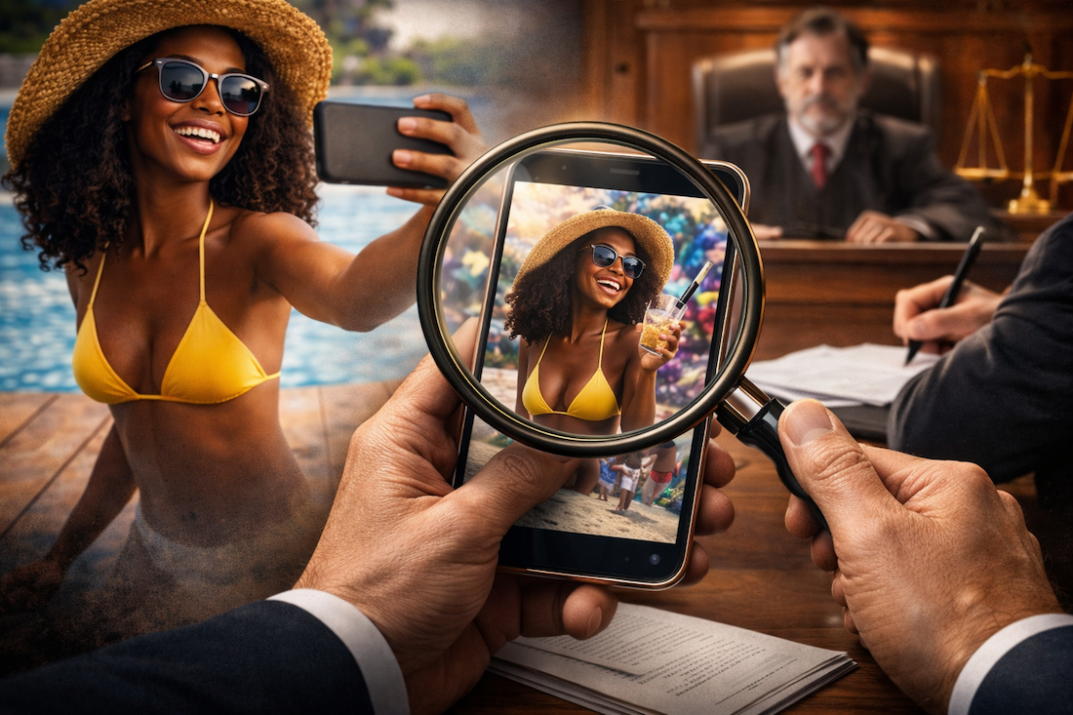
That holiday selfie, gym check-in or throwback video could be the very thing that destroys your personal injury claim.
According to legal expert Kirstie Haslam, partner at DSC Attorneys, courts in South Africa and around the world are increasingly relying on social media content from Facebook posts and Instagram stories to WhatsApp voice notes and fitness app data as admissible evidence in personal injury cases.
“What many claimants don’t realise is that even innocent-looking posts can be used to undermine credibility, contradict medical claims, or trigger allegations of fraud,” she says.
In one high-profile overseas case, a man who claimed a workplace accident left him permanently disabled saw his case unravel when his social media activity told a different story. The court ordered that his profiles be handed over as evidence, a move that is becoming increasingly common.
Haslam says that anyone pursuing a personal injury claim should assume their digital life is under scrutiny. “People underestimate how closely their online activity is monitored once a claim is lodged,” she says. “What you post and what others post about you can have serious legal consequences.”
Your Social Media Is Not Private and It Can Be Used Against You
“Photographs, comments and videos shared on social media are admissible as evidence in court,” Haslam explains. “Once a claim is instituted, insurers and defence attorneys often deploy dedicated teams to scour the internet for material that supports or contradicts a claimant’s version of events.”
This doesn’t only apply to civil matters. Social media investigations may arise in both civil and criminal cases, and platforms ranging from Facebook and Instagram to WhatsApp and Strava have all been used as evidentiary sources.
“If someone exaggerates or misrepresents the physical, emotional or psychological impact of an injury online, it can seriously compromise their case,” says Haslam. “In extreme circumstances, it can even lead to criminal charges such as fraud.”
It’s Not Just What You Post – It’s What Others Post About You
Claimants often assume they’re safe if they simply stop posting themselves. That’s a dangerous assumption.
“Posts made by friends and family are fair game,” Haslam warns. “Photographs you’re tagged in, comments made about you, or videos showing your activities can all be submitted as evidence.”
Even attempts to delete content or deactivate accounts can backfire. “Courts may view this as an attempt to conceal evidence, which can further damage credibility,” she adds.
Three Ways Social Media Can Sink Your Claim
1. Undermining your credibility
If a claimant alleges severe limitations on their lifestyle, but their social media suggests otherwise, like frequent travel, parties, sporting activity, defence lawyers will use that inconsistency to cast doubt on the entire claim.
2. Directly contradicting your injuries
Photos, videos, text posts, location data and fitness tracking apps can all be used to challenge the extent or existence of an injury. In one case, cycling data from a fitness app contradicted a claimant’s assertion that a knee injury left him unable to ride.
3. Accidental admissions of fault
Off-hand comments, jokes or emotional posts can amount to admissions of partial or full liability. Even if a claim is valid, discussing the incident publicly can have unintended and damaging consequences.
Haslam says that social media evidence is admissible in South Africa. “South African courts have repeatedly ruled that social media content may be admitted as evidence, provided it meets legal requirements such as relevance, authenticity and originality,” she adds. “Ultimately, it’s up to the court to decide what weight that evidence carries but the idea that online content is off-limits is simply wrong.”
She explains that local cases involving racist remarks, defamatory statements and even WhatsApp voice notes have reinforced the principle that digital communications can and will be used in court.
Privacy Rights Don’t Guarantee Protection
Even unlawfully obtained social media content may still be ruled admissible.
“In one case, defamatory Facebook statements were admitted despite having been obtained through hacking,” says Haslam. “Although the court acknowledged a violation of privacy, the evidence was allowed because it was relevant and probative.”
The takeaway is stark: privacy breaches don’t automatically disqualify evidence if it is considered crucial to establishing the truth.
A Global Trend That’s Only Accelerating
Internationally, courts have consistently expanded access to social media evidence in personal injury cases. Landmark rulings in the US, UK and Europe have confirmed that privacy settings do not necessarily shield relevant content from disclosure.
“As digital footprints grow, so does their evidentiary value,” says Haslam. “This trend is not going away, it’s accelerating.”
How to Protect Yourself If You’re Pursuing a Claim
If you’ve instituted a personal injury claim or are awaiting settlement, Haslam advises taking immediate precautions:
- Stop posting comments, photos or videos on social media
- Never post about your accident, injury or recovery
- Increase privacy settings across all devices and platforms
- Disable search visibility where possible
- Be cautious of new online ‘friends,’ they may be investigators
- Remove personal photographs from public platforms
- Do not delete devices or data, as this may be viewed as destruction of evidence
- Avoid online forums or chat groups discussing your case
Haslam says that the Bottom Line is that social media can undo years of careful legal work in seconds. “If you’re pursuing a personal injury claim, the safest approach is to treat every post as if it could be read aloud in court because one day, it might be,” she concludes.
For more information visit: www.dsclaw.co.za.
